
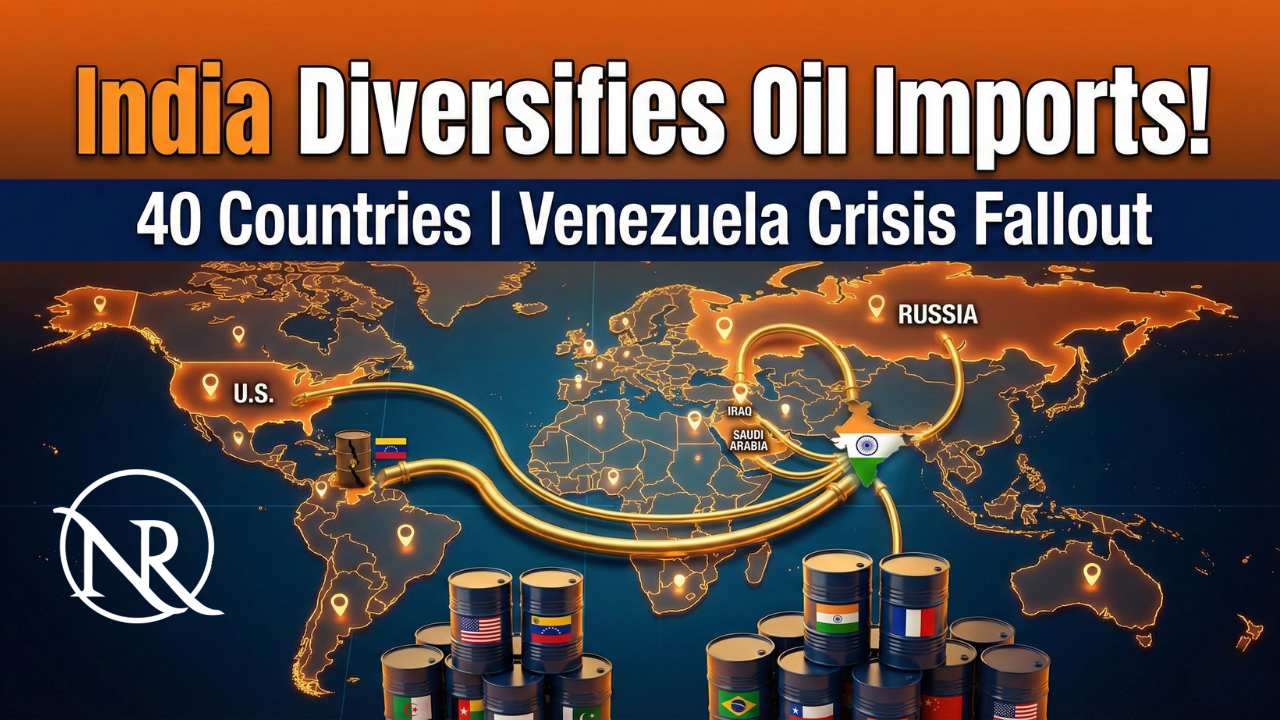
India Adds Oil Suppliers to 40 Countries in First Year of Venezuelan Crisis
India’s success in its long-term energy diversification quest is paying off. As with the U.S. military operation that resulted in the capture of Venezuelan President Nicolás Maduro, New Delhi has been relatively insulated from potential oil-supply shocks — this time because Venezuela now accounts for less than 1% of India’s crude imports.
As the Venezuela Crisis Spills Over, Why India Remains Muted?
Despite having the world’s largest proven oil reserves, Venezuela now puts out about a million barrels a day — less than 1 percent of global production. And over the years of sanctions and underinvestment, that reality had muted its influence in global markets. Oil prices epitomized such equanimity: despite a spike in early January, with Brent crude hovering near $61 per barrel, oversupply worries still seemed to trump geopolitical risk.
as a senior official put it, “marginal” in the overall Indian crude basket, the ongoing crisis isn’t relevant to India’s import mix.
India’s Supply Base: 27 to ~40 Countries
India has widened its base of crude suppliers from 27 to around 40 countries, including Argentina. This action enhances supply resilience and bargaining power across grades and geographies.
How India’s Import Mix Has Changed
Russia: roughly 35 to 36 per cent of imports in 2025 (with a potential fall in January, 2026 under new U.S. pressure)
Iraq: ~20–23%
Saudi Arabia: ~16–18%
UAE: ~8–10%
United States: ~6–7% (imports +~92% first 8 months of the fiscal year)
Middle Eastern suppliers — Saudi Arabia, Iraq and Kuwait — have recently increased the supply of crude to Indian refiners, making up for volatility elsewhere.
The Decline of Venezuela in India’s Fracturing Energy Mix
Through November 2025, India bought just $255.3 million worth of Venezuelan oil — that amounts to a scant 0.3% of its overall imports, according to Hellenic Shipping News Services, which tracks shipping data. That’s a steep drop from 12.4% in 2013, quickened after 2020 by onerous U.S. sanctions that limited exports and access to financing and technology.
To Venezuela to curb such imports due to warnings of increased tariffs on countries continuing business with the South American nation nearly a year later.
What Could Change Going Forward?
While any return to stability in Venezuela would send shock waves through the global energy markets, analysts say it would have little lasting impact on India. Venezuelan oil is largely heavy and high in sulfur, better qualified for complex refineries.