
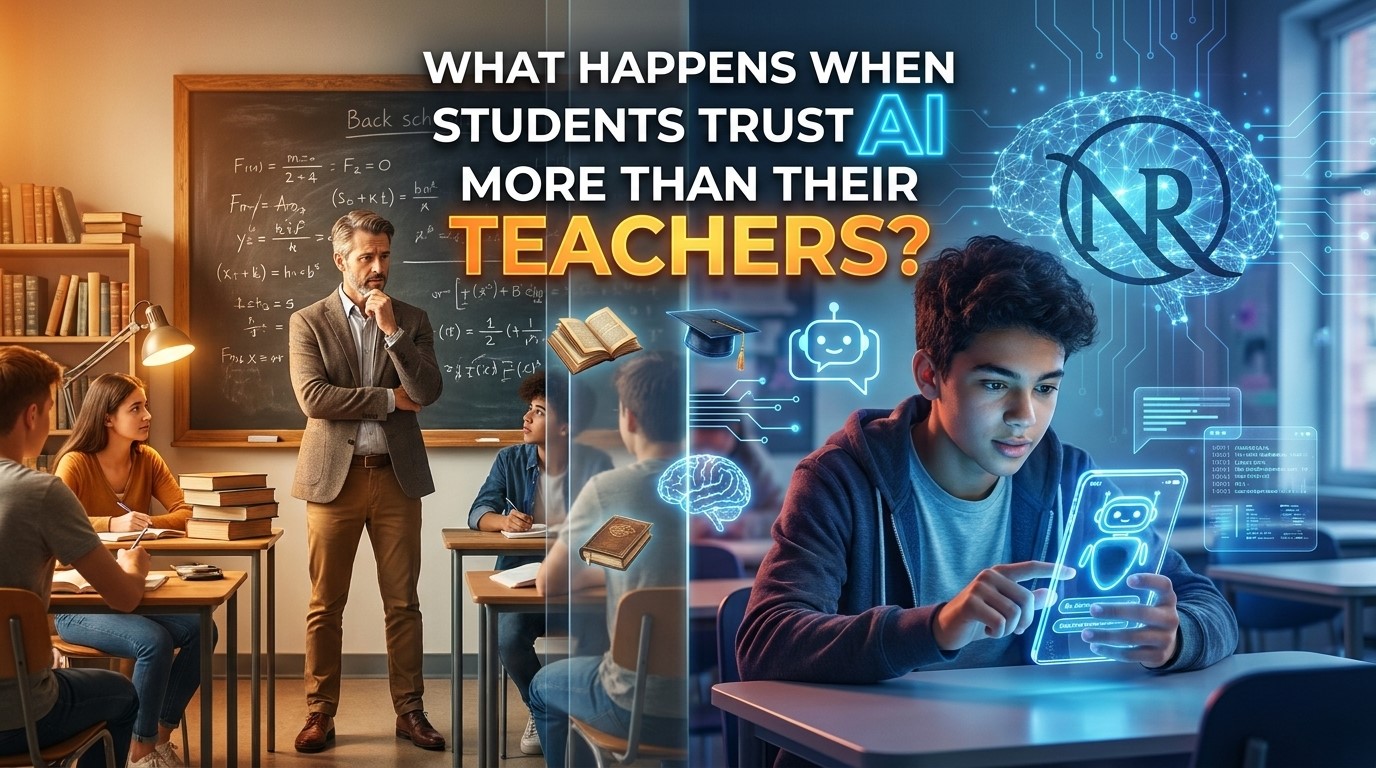
What Happens When Students Trust AI More Than Their Teachers?
Walk into almost any high school classroom in 2026 and you’ll see a familiar scene: a student stuck on a problem reaches for a phone or laptop and asks an AI chatbot before raising a hand. It isn’t laziness or disrespect—it has simply become the fastest way to get help. For many students, AI has quietly become the first stop for questions, forcing schools to confront an important issue: what happens to learning, authority, and trust when the machine answers first?
The New First Responder
For decades, the classroom hierarchy was simple. Students asked teachers when they were confused. If class was over, they turned to parents, classmates, or tutors. Teachers were more than information providers—they guided students, corrected misunderstandings, and tracked learning over time.
That pattern is changing. AI tools are available instantly, without appointments or classroom pressure. Students can ask the same question repeatedly, request simpler explanations, and receive personalized responses within seconds. Whether it’s during homework late at night or while studying for an exam, AI is always available.
This shift isn’t limited to a handful of technology-focused schools. From public classrooms to private academies, students now have access to AI through smartphones and laptops, making it one of the most accessible learning tools ever created.
Why Students Choose AI
Students aren’t turning to AI simply because it’s easier—they’re doing it because it removes many of the barriers to asking for help.
Many teenagers hesitate to ask questions in front of classmates for fear of appearing behind or making mistakes. AI removes that social pressure completely. It doesn’t judge, become impatient, or remember yesterday’s confusion.
AI is also endlessly patient. Teachers often manage classrooms of thirty students with limited time, while AI can explain the same concept repeatedly using different examples until something clicks.
Availability is another advantage. Learning often happens after school, when teachers are unavailable. AI fills that gap instantly, providing explanations whenever students need them.
Although AI isn’t necessarily a better teacher, it solves the friction involved in asking for help—something education has struggled with long before chatbots existed.
The Trust Challenge
The real concern isn’t that students use AI. It’s who they trust.
Teachers are accountable for student learning. They can identify misconceptions, adjust lessons, and provide ongoing support. AI cannot. While modern AI often produces useful explanations, it can also generate confident but incorrect answers. Younger students may not have the knowledge needed to recognize those mistakes, making fluency easy to confuse with accuracy.
There’s another consequence as well. Every question asked in class gives teachers valuable insight into what students understand—and what they don’t. When those questions are asked privately through AI instead, teachers lose visibility into learning gaps and may miss opportunities to address misunderstandings before they become bigger problems.
It’s About More Than Cheating
AI in schools is often discussed as a cheating problem, but that overlooks how many students actually use it.
Some students certainly rely on AI to complete assignments without doing the work themselves. However, many use it like a tutor or study partner—to clarify concepts, check their reasoning, or explain difficult topics in different ways.
The real challenge isn’t deciding whether students should use AI. That decision has largely been made by students themselves. The challenge is teaching them how to use AI responsibly so it supports learning rather than replacing critical thinking.
The Future of Teaching
Schools are still adapting. Some districts have introduced AI policies and classroom guidelines, while others leave decisions to individual teachers. This creates inconsistent expectations, with students encountering different rules from one classroom to the next.
Ultimately, this isn’t just a technology issue—it’s a trust issue. Teachers have never been valuable simply because they possess information. Their real value lies in judgment, relationships, encouragement, and the ability to recognize when students are struggling before they even ask for help.
AI can answer questions, but it cannot replace the human connection that motivates students, builds confidence, and teaches them how to think critically. Used well, AI could reduce repetitive tasks and give teachers more time to focus on mentoring, discussion, and deeper learning.
The future of education doesn’t depend on choosing between teachers and AI. It depends on combining the strengths of both. AI can provide instant support, while teachers provide the context, accountability, and relationships that meaningful learning requires. If schools can strike that balance, students won’t just learn faster—they’ll learn better.
